
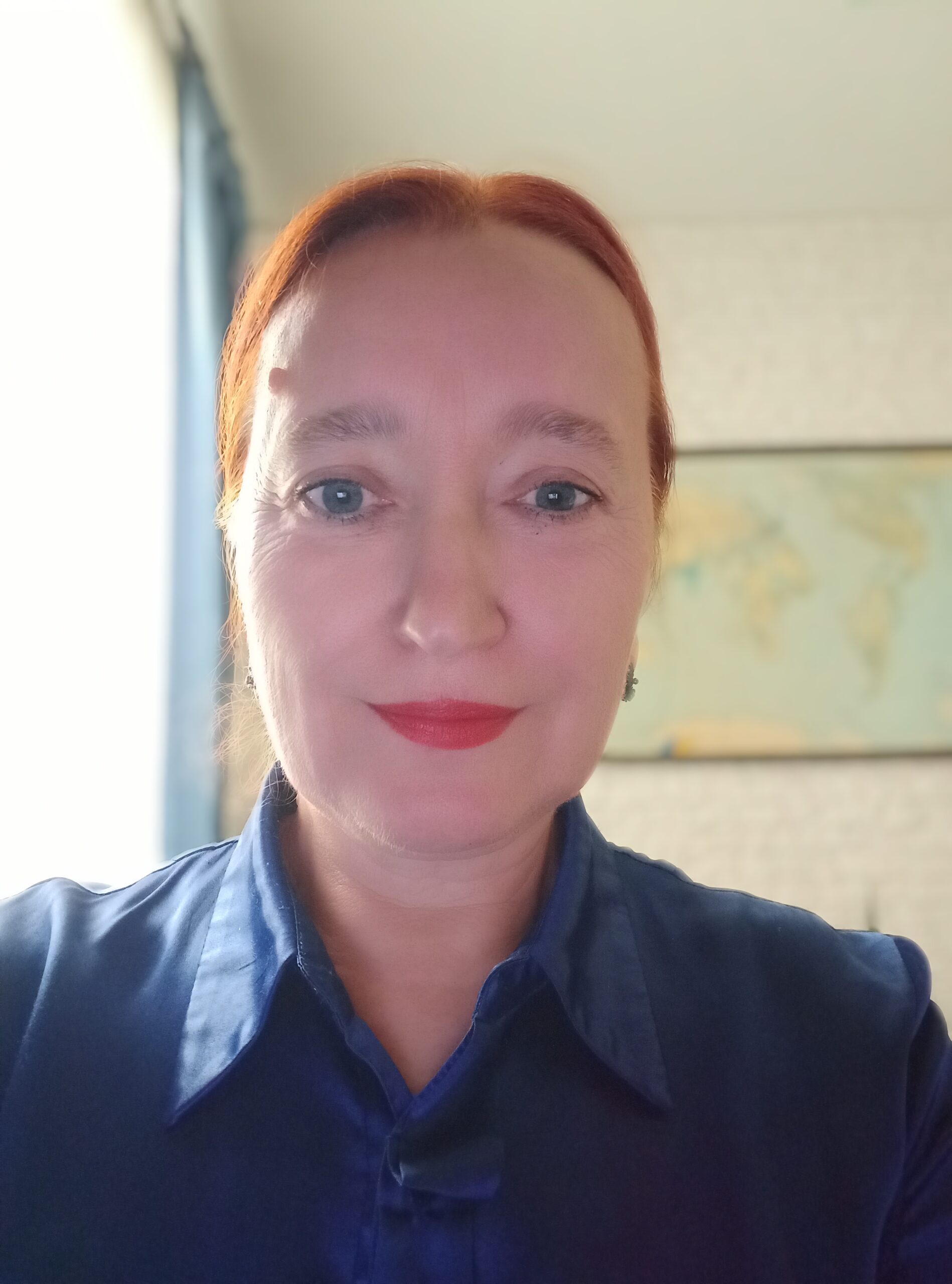

Oksana Leontyeva, PhD, independent researcher, Associate Professor, KROK-
University, Kyiv, Ukraine. She has been working with international students for over
20 years and conducts research in the field of intercultural communication. Being in
constant contact with representatives of different cultures, which sometimes differ
radically from each other, Dr Oksana Leontyeva became interested in
interdisciplinary research that helps shed light on models of culture related to the
perception of the world and its representation in thought processes, and not only in
material creativity. Such cultural models are based on ways of perceiving the world,
which is why Dr. Oksana Leontieva's research focuses on the ways in which cultures
perceive the world, the distinctive features of cultural perceptions of the world, and
the specificity of their worldviews. Accordingly, all these factors influence the
uniqueness of thinking among representatives of different cultures, which is
manifested through language. Dr Oksana Leontieva's research touches upon
neuropsychological and neurocognitive factors that determine the characteristics of a
culture's perception of the world and the values that this culture professes. Dr
Leontieva's research touches not only on linguistics, but also on neuroscience,
anthropology, medicine, philosophy and psychology.
Dr Oksana Leontieva is a member of an international research group at the Institute
of Slavic Studies at Karl-Franzens University in Graz (Austria) studying the work of
Nobel Prize winner Ivo Andrić. There she works as a researcher specialising in
cognitive semantics. For one year, Dr Oksana Leontieva worked as a visiting
professor at the Institute of East Slavic Philology at Jagiellonian University (Krakow,
Poland). Completed a research internship at the Institute of Interdisciplinary Studies
at the University of Warsaw (Warsaw, Poland). Internship topic: The influence of
cultural models on the formation of political discourse. She gave a presentation on
the differences between Western and Eastern political discourses at an international
conference in Tehran (Iran). Representatives from more than 15 countries in Europe
and Asia participated in the conference. She is a member of two international
scientific societies.
For eight years, she headed the Department of Foreign Languages and was the
initiator and editor-in-chief of the scientific journal Focus of Language. She has been
awarded two certificates of honour from the Ministry of Education and Science of
Ukraine as the best teacher and for her significant contribution to the development of
science and education in Ukraine. As head of the department, she collaborated with
many diplomatic missions in Ukraine, thereby promoting knowledge about different
countries and their cultures to Ukrainian students. Author of several language
teaching methods for foreign students, taking into account the specifics of their
culture. For example, the method developed for Chinese students allowed them to
master communication in Russian at the A1 level in 2 months instead of 10. Author
of many publications in international English-language journals.
She wrote the chapter ‘Marketing Mistakes in Intercultural Communication’ for the
book ‘Marketing,’ published in 2024 by IntechOpen. The latest published scientific
research concerns the way culture perceives the world, the mechanism of formation
and display of sacral-value relations in the language of culture, basic determinants as
prerequisites for a culture to form its way of knowing the world, thought-forms and
primary mental cognitions as a basis for the formation of the way culture knows the
world. informational and semantic errors that arise when translating cultural codes in
intercultural communication, the role of language in shaping cultural value models,
the influence of semantic fields that arose in the early stages of cultural formation on
its value models, and the role of sacred connections in shaping cultural value models.
She proposed introducing the new concept of Homo excultus as the highest form of
Homo sapiens, understood as a person of values, and explained the need for
introducing such a concept.
She has been a speaker at numerous international conferences, including in Iran,
Poland, Austria, Montenegro, Spain, Russia, and Serbia. She has participated
remotely (abstracts and articles) in scientific conferences held in China.
Dr.Oksana Leontyeva has won the IMIRAC INTERNATIONAL BEST RESEARCHER in COGNITIVE SCIENCE-2026